Projects

Hidden Markov Models for fMRI Brain Dynamics

2024–Present
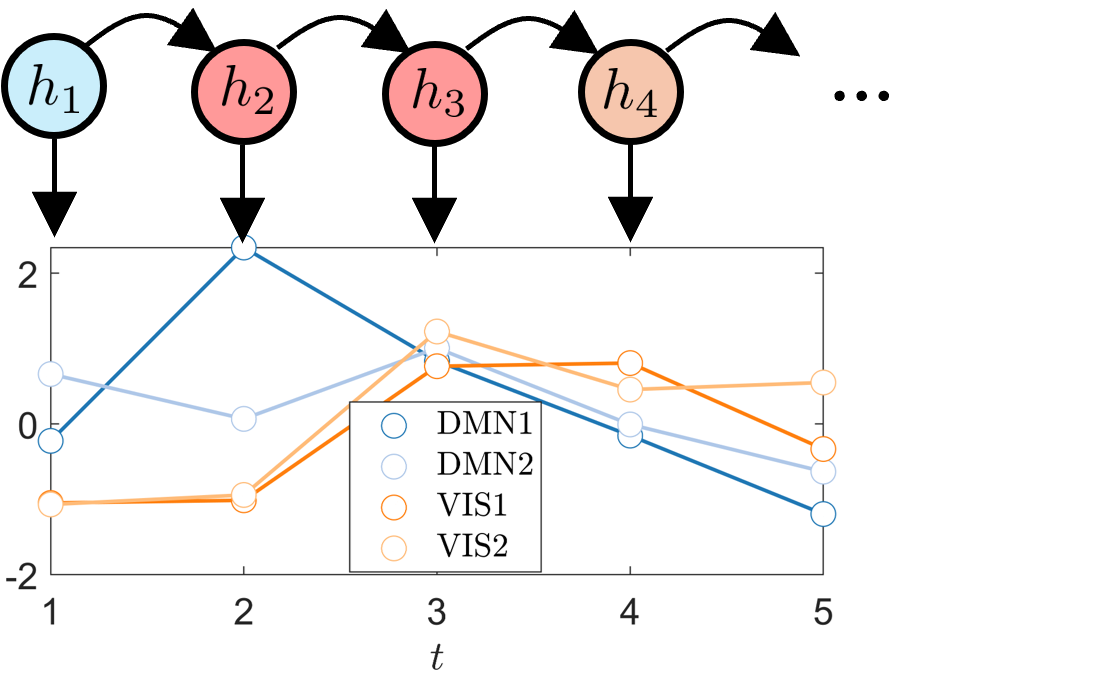
Hidden Markov models for fMRI brain dynamics

This project applies Hidden Markov Models (HMMs) to fMRI for studying time-varying brain activity and functional connectivity. HMMs provide a probabilistic framework for identifying recurring brain states and characterizing how the brain transitions between different patterns of activity over time.

Our work uses HMM-based analysis across resting-state and task fMRI to investigate brain dynamics and their relationships with neurological and cognitive processes.
Nonlinear KCCA for fMRI Activation Detection

2025–2026
Nonlinear KCCA for fMRI activation detection

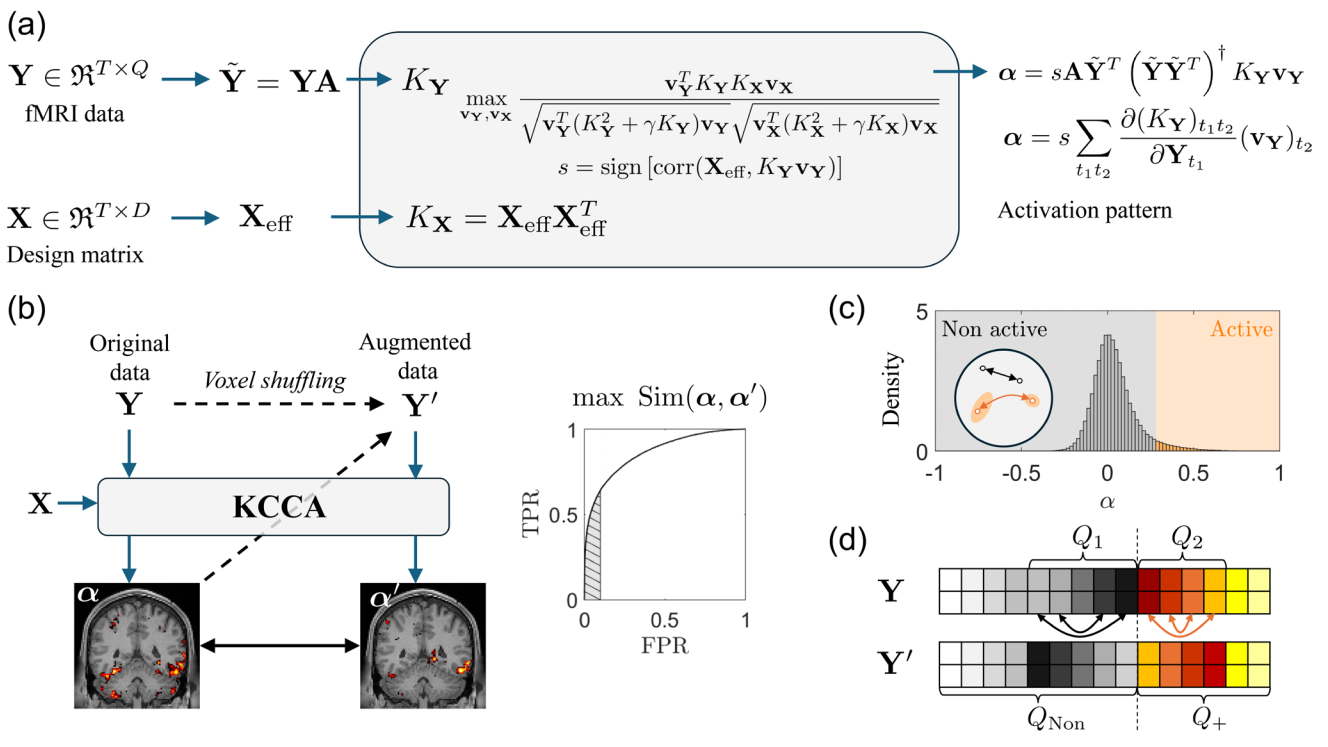
This project develops nonlinear Kernel Canonical Correlation Analysis (KCCA) for task-fMRI activation detection. By extending conventional linear KCCA to nonlinear kernel spaces, the method captures more complex relationships between fMRI signals and task-related neural responses while retaining efficient whole-brain activation analysis.

We further developed self-supervised optimization for parameter selection and robust back-reconstruction methods for mapping nonlinear representations back to voxel-level activation patterns. Together with systematic kernel selection, these developments improve activation accuracy and robustness across simulated and real task-fMRI datasets.

Selected Publications

  • Chendi Han, Zhengshi Yang, Xiaowei Zhuang, and Dietmar Cordes, “Nonlinear kernel-based fMRI activation detection,” Frontiers in Neuroimaging 4, 1649749 (2025). Paper Link · PDF
  • Chendi Han, Zhengshi Yang, Xiaowei Zhuang, and Dietmar Cordes, “Nonlinear KCCA in fMRI activation analysis: Self-supervised optimization and robust back-reconstruction,” Imaging Neuroscience 4, IMAG.a.1243 (2026). Paper Link · PDF

Meta-Learning for Data-Efficient Scientific Applications

2023
Meta-learning-based quantum scar detection

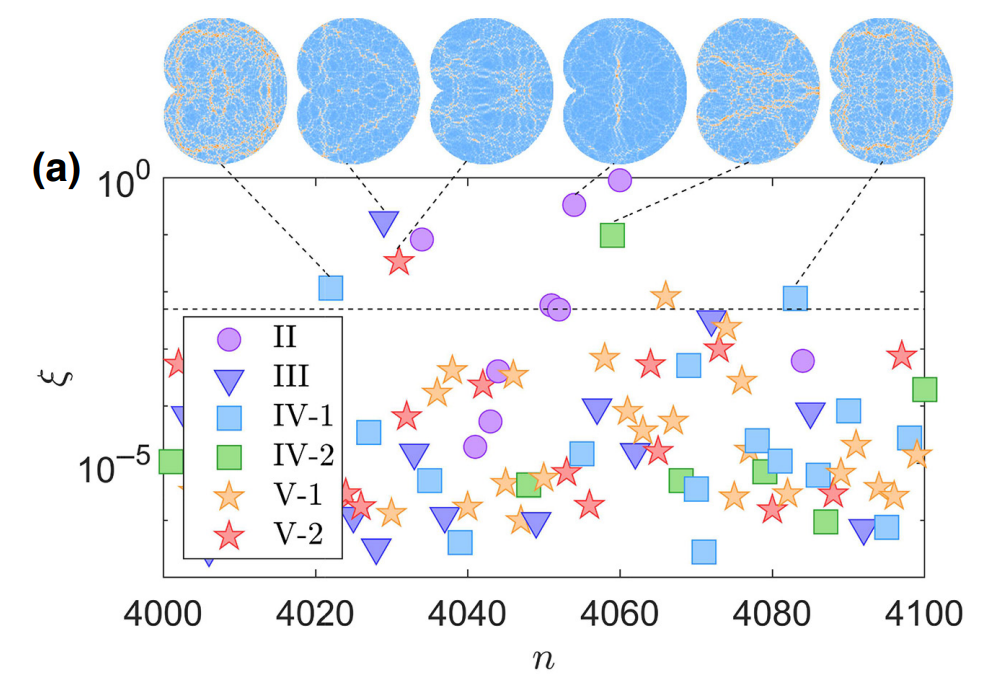
This project explores meta-learning for scientific applications where labeled data are extremely limited. Optimization-based meta-learning uses a nested learning process to identify neural networks that can rapidly adapt to new tasks from only a few examples.

We applied this idea to quantum scar detection, where distinct scarring states are rare and conventional deep learning is limited by the lack of training data. By combining meta-learning and few-shot classification, we developed a fully automated detector that can identify quantum scars from thousands of wave functions using only a few labeled examples, demonstrating the potential of meta-learning for data-limited detection problems across science and engineering.

Selected Publications

  • Chen-Di Han, Cheng-Zhen Wang, and Ying-Cheng Lai, “Meta-Machine-Learning-Based Quantum Scar Detector,” Physical Review Applied 19, 064042 (2023). Paper Link · PDF

Deep-Learning-Based Device Design

2022–2024
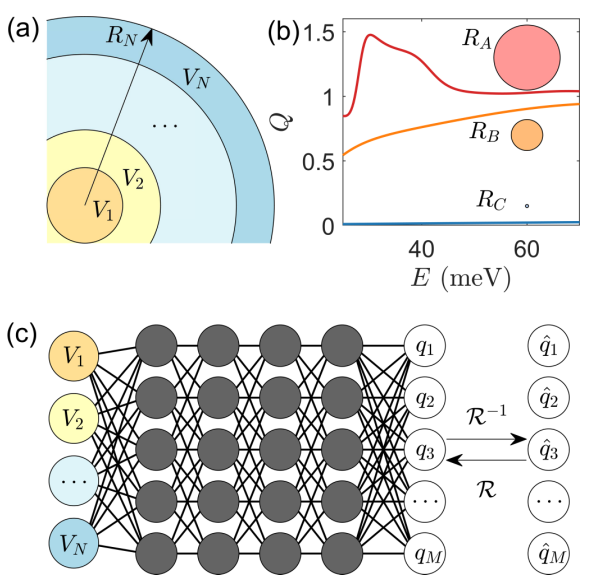
Deep-learning-based inverse design of graphene electronic devices

This project develops deep-learning-based inverse-design methods for electronic devices, replacing computationally expensive physics solvers with neural networks and directly optimizing device configurations for desired physical responses.

We first applied this approach to graphene quantum dots to design gate-potential configurations for extreme quantum scattering, including cloaking and superscattering. We further developed deep-learning-designed graphene electronic metasurfaces for controlling Dirac electron waves, enabling applications such as electron holography, wavefront engineering, and multifunctional electronic devices.

Selected Publications

  • Chen-Di Han and Ying-Cheng Lai, “Generating extreme quantum scattering in graphene with machine learning,” Physical Review B 106, 214307 (2022). Paper Link · PDF
  • Chen-Di Han, Li-Li Ye, Zin Lin, Vassilios Kovanis, and Ying-Cheng Lai, “Deep-learning design of electronic metasurfaces in graphene for quantum control and Dirac electron holography,” APL Machine Learning 2, 036105 (2024). Paper Link · PDF

Physics-Enhanced Machine Learning

2020–2021
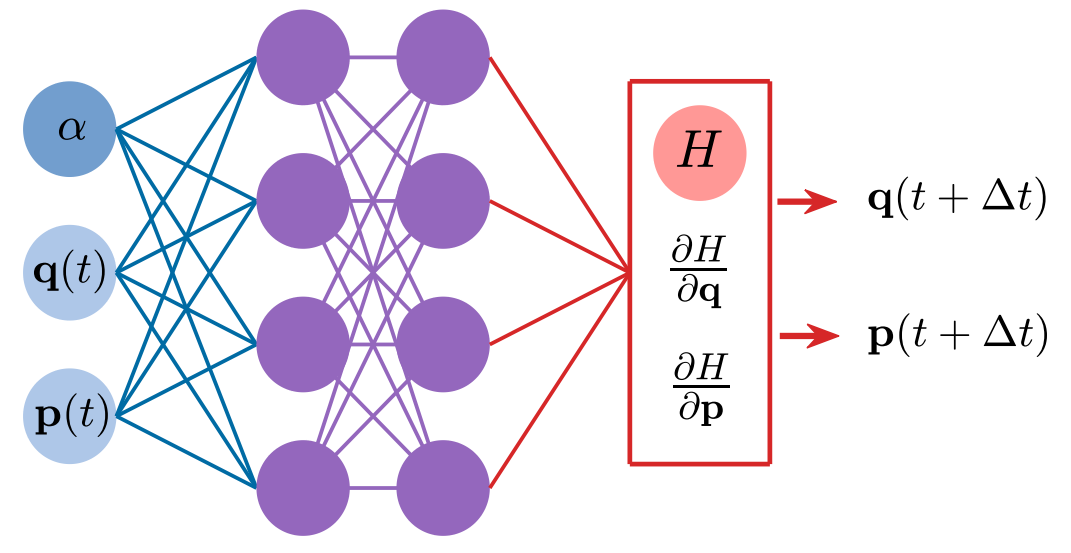
Physics-enhanced neural networks for dynamical systems

This project develops physics-enhanced neural networks that incorporate governing physical laws directly into model learning. We introduced two physics-driven neural-network frameworks for learning classical and quantum dynamical systems from limited data.

The first, an adaptable Hamiltonian neural network, incorporates Hamilton's equations and system parameters to predict nonlinear dynamics across unseen parameter regimes, including transitions to chaos. The second, a Heisenberg neural network, incorporates the Heisenberg equation of motion to reconstruct time-dependent quantum Hamiltonians and their interaction structures from sparse local measurements.

Selected Publications

  • Chen-Di Han, Bryan Glaz, Mulugeta Haile, and Ying-Cheng Lai, “Adaptable Hamiltonian neural networks,” Physical Review Research 3, 023156 (2021). Paper Link · PDF
  • Chen-Di Han, Bryan Glaz, Mulugeta Haile, and Ying-Cheng Lai, “Tomography of time-dependent quantum Hamiltonians with machine learning,” Physical Review A 104, 062404 (2021). Paper Link · PDF

Electronic and Optical Properties of Pseudospin-1 Systems

2017–2019
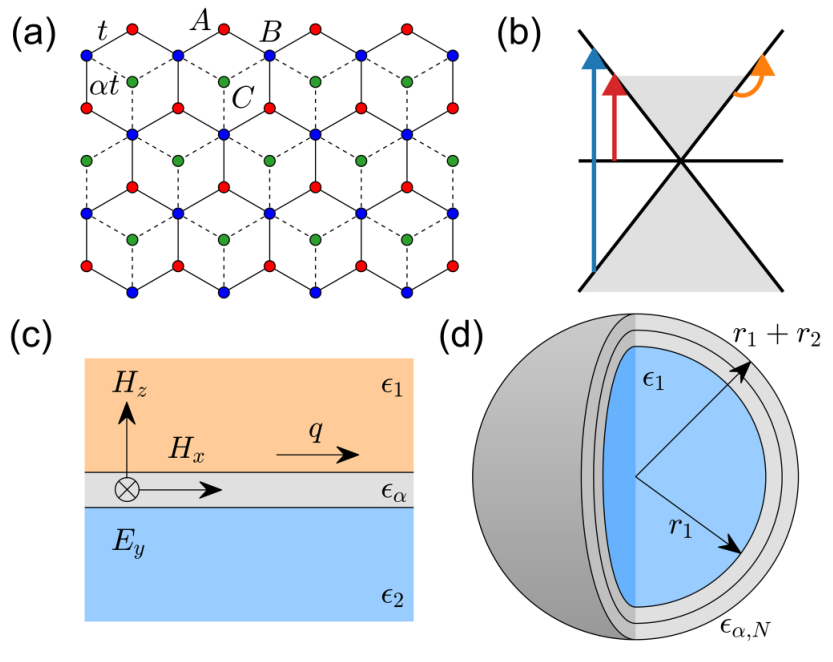
Electronic and optical properties of pseudospin-1 systems

This project investigates electronic and optical phenomena in two-dimensional pseudospin-1 Dirac systems, whose energy bands consist of two Dirac cones intersected by a flat band. We studied how this unique band structure modifies Coulomb-impurity physics, electronic transport, and optical response.

A central contribution was, to our knowledge, the first analytical treatment of atomic collapse in pseudospin-1 systems and the derivation of a complete analytical expression for the optical conductivity of flat-band Dirac materials. These results reveal distinctive flat-band effects, including singular conductivity, unusual interband transitions, and resonant optical scattering.

Selected Publications

  • Chen-Di Han, Hong-Ya Xu, Dan-Hong Huang, and Ying-Cheng Lai, “Atomic collapse in pseudospin-1 systems,” Physical Review B 99, 245413 (2019). Paper Link · PDF
  • Chen-Di Han and Ying-Cheng Lai, “Optical response of two-dimensional Dirac materials with a flat band,” Physical Review B 105, 155405 (2022). Paper Link · PDF